A practical survival roadmap for your first month in a new country, from the moment you land to the moment you finally feel settled.

You packed your bags. You said goodbye to people you love. You probably imagined this moment a hundred times, stepping off the plane, entering a new country, and finally beginning the life you worked so hard to build.
But here is something nobody tells you enough:
Arriving is only the beginning.
The first 30 days in a new country can feel exciting, confusing, lonely, expensive, overwhelming, and sometimes all in the same day.
You may find yourself asking:
Where do I go first?
How do I get a phone number?
Where do I buy groceries?
How does transportation work?
When should I open a bank account?
Who do I call when I need help?
And why does everything suddenly feel so unfamiliar?
This is the part of moving abroad that beautiful airport pictures don’t show you.
So, MoveWise Africa created this guide to walk with you through your first month, not as a perfect checklist, but as a realistic roadmap.
Because the goal isn’t to have your entire new life figured out in 30 days.
The goal is to move from “I just arrived” to “I know what I’m doing.”
THE 5-STAGE JOURNEY OF YOUR FIRST 30 DAYS
Your first month abroad isn’t one big adjustment. It happens in stages.
This roadmap breaks those first 30 days into five practical stages — so you can focus on what matters now instead of feeling like you have to figure everything out at once.
You don’t have to do it all at once. One step. One day. One victory at a time.
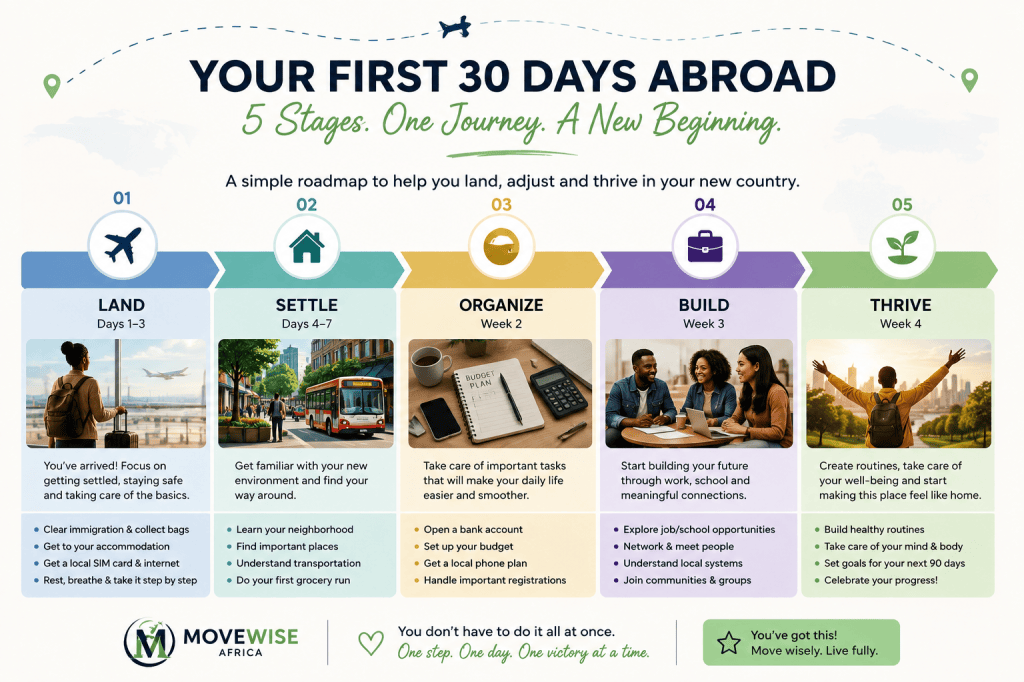
✈️ LAND — DAYS 1–3
You made it.
After the planning, paperwork, packing, goodbyes, long flights, and all the emotions that came with leaving home, you have finally arrived.
And now comes the part nobody really prepares you for:
What do I actually do first?
The first three days are not about building your entire new life. They are about getting safe, getting settled, getting connected, and giving yourself time to breathe.
You don’t need to know everything yet.
Your only job is to take care of the basics.
1. Clear Immigration and Collect Your Bags
Your first priority is simply getting through the airport and leaving with everything you arrived with.
Depending on your destination, you may need to go through immigration, customs, baggage claim, and possibly additional screening before you can leave the airport.
Keep your important documents somewhere easy to reach.
- Passport
- Visa or immigration documents
- Accommodation address
- Flight information
- Emergency contact information
- Any documents you may need to show an immigration officer
Don’t put these documents at the bottom of your suitcase.
You may be tired, nervous, or overwhelmed. That’s normal.
Take your time, follow the signs, and ask airport staff when you are unsure where to go.
You don’t have to figure out the entire airport by yourself.
2. Get to Your Accommodation Safely
Once you have your bags, your next goal is simple:
Get somewhere safe and rest.
Whether you’re staying with family, in student housing, renting an apartment, or using temporary accommodation, make sure you know exactly where you’re going before leaving the airport.
If someone is picking you up, confirm their name and contact information.
If you’re using public transportation or a taxi/rideshare service, use the official service available at the airport.
Keep your phone charged and your location details accessible.
Your first night is not the night to start exploring the entire city.
Get to your accommodation.
Eat something.
Take a shower.
Sleep.
You’ve travelled far enough.
3. Get Connected
One of the first things you will need in a new country is a reliable way to communicate.
A local SIM card or eSIM can make your first few days much easier.
You’ll need your phone for:
- Directions
- Transportation
- Communication
- Banking
- Emergencies
- School or work
- Finding nearby services
Don’t worry if you don’t understand all the phone plans immediately.
Start with what you need now.
You can always change your plan later when you understand the options better.
4. Keep Your First Day Simple
There is a temptation to start doing everything immediately.
Don’t.
Your first day should be about recovering from the journey and making sure you have the basics.
Ask yourself:
- Where am I sleeping tonight?
- Do I have food and water?
- Is my phone working?
- Do I know how to contact someone if I need help?
- Do I have access to my important documents and money?
If the answer is yes, you’re doing fine.
You don’t need to open every account, visit every store, find a job, and learn the entire transportation system in one day.
One thing at a time.
5. Rest Without Feeling Guilty
You may feel like you should be productive because you have finally arrived.
But travelling is exhausting.
Your body is adjusting to a new environment, your mind is processing a huge life change, and you may be dealing with jet lag.
Rest is not wasting time.
Rest is part of settling in.
Give yourself permission to slow down.
Your LAND checklist
By the end of Days 1–3, aim to have these basics handled:
- Immigration and airport procedures completed
- Bags collected
- Safe accommodation confirmed
- Phone/SIM or eSIM working
- Basic food and water available
- Important documents kept safely
- A way to get around identified
- Someone you trust knows you have arrived
- Enough time to rest and recover
You don’t need a perfect first three days.
You just need a safe first three days.
🏠 SETTLE — DAYS 4–7
You survived the first few days. Now it’s time to start learning your surroundings.
The first days were about arriving.
Now, you’re beginning to live.
This is when the new country starts becoming more than just the place you landed.
You begin learning where things are, how transportation works, where to buy food, and what your neighbourhood feels like.
You don’t need to know the whole city.
You just need to know your corner of it.
1. Learn Your Neighbourhood
Start close to home.
Find out where you can access the things you will need regularly.
Look for:
- Grocery stores
- Pharmacies
- Banks or ATMs
- Public transportation stops
- Hospitals or clinics
- Schools or workplaces
- Places of worship, if relevant to you
- Laundromats or other essential services
Save important locations on your phone.
Knowing what’s around you will make the new environment feel less intimidating.
2. Understand Transportation
Transportation can be one of the biggest adjustments when you move abroad.
Learn:
- How buses, trains, or subway systems work
- How to pay for transportation
- Where to get your transportation card or pass
- How to check schedules
- How to plan a route
- What time transportation usually stops running
Don’t try to master the entire system.
Start with the routes you are most likely to use.
Your accommodation → school.
Your accommodation → work.
Your accommodation → grocery store.
Those routes alone can give you confidence.
3. Do Your First Grocery Run
Your first grocery trip can be surprisingly emotional.
You may walk through an entire store and realize that many of the brands, products, prices, and measurements are different from what you’re used to.
That’s okay.
Don’t try to buy everything at once.
Start with the basics.
- Water
- Bread or other staple foods
- Rice or your preferred staple
- Eggs
- Milk or an alternative
- Fruits and vegetables
- Snacks
- Basic toiletries
- Cleaning supplies
Then gradually learn where you prefer to shop.
4. Start Creating a Routine
Your new life will feel less chaotic when your days begin to have some structure.
You don’t need a perfect schedule.
Start with simple routines:
- Wake up around the same time
- Eat regular meals
- Keep your space clean
- Plan your transportation
- Set aside time for school or work
- Make time to rest
Routine gives your brain something familiar to hold onto while everything else is new.
Your SETTLE checklist
By the end of Days 4–7, aim to:
- Know your immediate neighbourhood
- Understand your main transportation routes
- Complete your first grocery shopping trip
- Identify important nearby services
- Know where to get help if needed
- Begin establishing a daily routine
You are no longer simply visiting.
You are beginning to live here.
💰 ORGANIZE — WEEK 2
Now that the immediate survival stage is over, it’s time to organize the practical parts of your new life.
This is where things like money, banking, phone plans, registrations, and important paperwork start becoming priorities.
You don’t have to complete everything in one day.
But you should start putting your life into order.
1. Open a Bank Account
If you haven’t already opened a local bank account, Week 2 is a good time to take care of it.
Find out what documents you need before going to the bank.
Ask questions about:
- Monthly fees
- Debit cards
- Credit cards
- Online banking
- Transfers
- ATM withdrawals
- International transfers
Don’t choose an account simply because someone told you it’s the best one.
Understand what you’re signing up for.
2. Create Your First Realistic Budget
Your first few weeks can be expensive.
There may be costs you didn’t expect:
- Transportation
- Groceries
- Phone bills
- Household items
- Deposits
- School expenses
- Work-related expenses
- Clothing for the weather
- Unexpected fees
Write down your regular expenses.
Then separate them into:
Needs
Wants
Unexpected expenses
A budget isn’t about stopping yourself from enjoying your new life.
It’s about knowing where your money is going.
3. Get Your Phone Plan Under Control
By now, you should have a better idea of how much data and calling you actually need.
Compare your options before committing to an expensive plan.
Ask:
- How much data do I really use?
- Do I need international calling?
- Is there a contract?
- Are there activation fees?
- Can I change the plan later?
The cheapest plan isn’t always the best.
The best plan is the one that fits your actual needs.
4. Handle Important Registrations and Paperwork
Depending on your destination and situation, you may have important registrations to complete.
These could include:
- School registration
- Government identification
- Health coverage
- Tax-related documents
- Employment paperwork
- Transportation registration
- Address updates
Keep copies of important documents in a secure digital location.
Create one folder for your new-country paperwork.
Future you will be grateful.
Your ORGANIZE checklist
By the end of Week 2, aim to:
- Have your banking arranged
- Understand your basic monthly expenses
- Create a realistic budget
- Have a phone plan that works for you
- Complete important registrations
- Organize your important documents
The goal isn’t to become financially perfect.
The goal is to stop feeling like your life is scattered everywhere.
💼 BUILD — WEEK 3
You have arrived.
You have settled in.
You have organized the basics.
Now you can start building.
This is where your attention shifts from:
“How do I survive here?”
to:
“How do I build a life here?”
1. Explore Work or School Opportunities
Depending on why you moved, this may mean finding work, starting school, continuing your education, or exploring professional opportunities.
Update your:
- Resume/CV
- LinkedIn profile
- Job profiles
- School documents
- Professional certifications
Start learning what employers or schools in your new country expect.
Don’t compare your beginning to someone else’s fifth year.
You’re building your foundation.
2. Start Meeting People
One of the hardest parts of moving abroad can be rebuilding your social circle.
You may suddenly realize that the people you used to call whenever you wanted are now thousands of kilometres away.
Start small.
Talk to classmates.
Speak to colleagues.
Join community activities.
Attend events.
Reconnect with people from your country when it helps you feel grounded.
But also give yourself opportunities to meet people outside your existing circle.
3. Understand the Systems Around You
Every country has systems that take time to understand.
Learn how things work instead of being afraid to ask questions.
You may need to understand:
- Healthcare
- Banking
- Transportation
- Employment
- Education
- Housing
- Taxes
- Emergency services
You don’t need to memorize everything.
Know where to find reliable information when you need it.
4. Find Your Community
Community can make a new country feel less lonely.
Look for spaces where you can meet people with shared interests or experiences.
This could be:
- Cultural communities
- Student groups
- Professional networks
- Volunteer organizations
- Faith communities
- Sports or fitness groups
- Local community events
You don’t need hundreds of friends.
Start with a few meaningful connections.
Your BUILD checklist
By the end of Week 3, aim to:
- Begin exploring work or school opportunities
- Update your resume or professional profile
- Meet some new people
- Learn more about important local systems
- Find at least one community or group you can connect with
You’re no longer just adjusting.
You’re beginning to build.
🌱 THRIVE — WEEK 4
This is where your first month begins to come together.
You may still have questions.
You may still feel homesick.
You may still have days when everything feels unfamiliar.
That’s completely normal.
Thriving doesn’t mean you suddenly feel like a local.
It means you are beginning to feel capable.
1. Build Healthy Routines
Think about what makes you feel like yourself.
Maybe it’s cooking familiar food.
Going for walks.
Calling family.
Exercising.
Reading.
Praying.
Journaling.
Whatever helps you feel grounded, make space for it.
Your new life shouldn’t require you to lose yourself.
2. Take Care of Your Mind and Body
Moving abroad is a major life transition.
Give yourself room to experience the emotions that come with it.
You may feel:
- Excited
- Lonely
- Proud
- Confused
- Homesick
- Motivated
- Overwhelmed
Sometimes you may feel several of these in the same day.
That doesn’t mean you’re failing.
It means you’re adjusting.
Reach out for support when you need it.
You don’t have to carry everything alone.
3. Set Your Next 90-Day Goals
Your first 30 days were about getting established.
Now think about the next three months.
Ask yourself:
What do I want my life to look like 90 days from now?
Choose a few realistic goals.
Maybe you want to:
- Find a job
- Improve your finances
- Complete a course
- Build your professional network
- Make new friends
- Improve your language skills
- Find better housing
- Explore your city
- Create healthier routines
Don’t choose twenty goals.
Choose the ones that matter most.
4. Celebrate Your Progress
Before you rush into the next chapter, stop and look at how far you’ve come.
Thirty days ago, this place was unfamiliar.
Now you know where you sleep.
You know where to buy groceries.
You know how to get around.
You have started learning the systems.
You have probably made mistakes.
You have probably had difficult days.
And you’re still here.
That counts.
Your THRIVE checklist
By the end of Week 4, aim to:
- Have routines that make your days easier
- Take care of your physical and emotional well-being
- Have a few meaningful connections
- Know what your next 90-day goals are
- Recognize and celebrate your progress
You don’t need to have your whole life figured out.
You just need to know your next step.
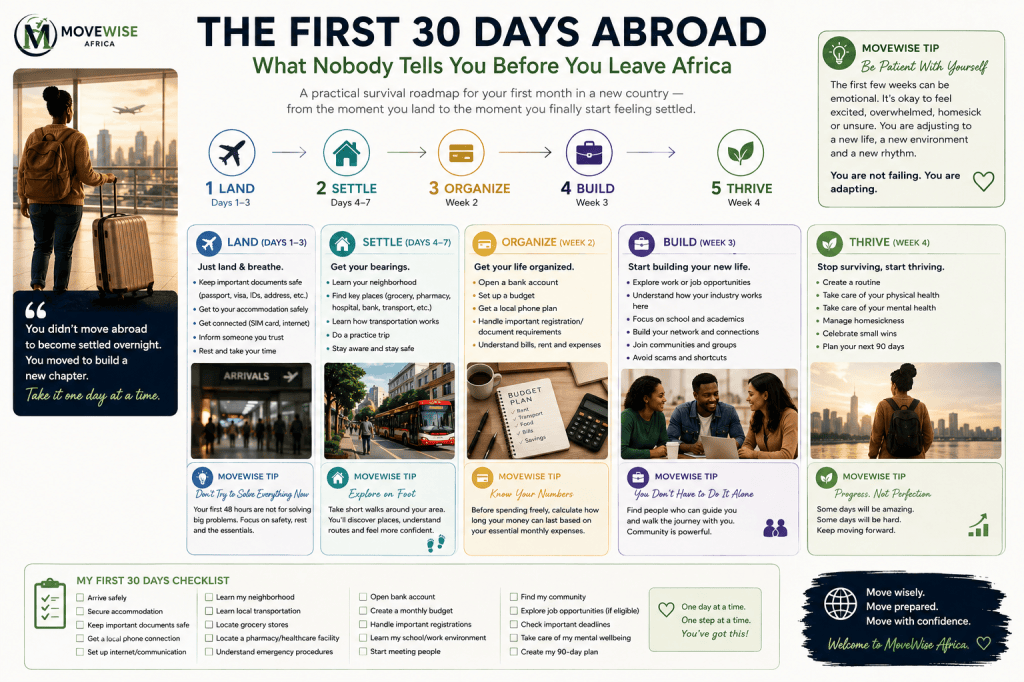
YOUR FIRST 30 DAYS: WHAT SHOULD YOU REALLY EXPECT?
Here’s the truth.
Your first month abroad probably won’t look like the pictures.
Some days will feel exciting.
Some days will feel lonely.
Some days you’ll feel like you made the best decision of your life.
Other days, you may wonder why you ever left home.
Both can be true.
The goal of your first 30 days isn’t to become completely settled.
It’s to build enough stability that you can begin moving forward.
THE 30-DAY MINDSET
Don’t measure your first month by how much you accomplished.
Measure it by how much you learned.
You learned how to navigate.
You learned how to ask for help.
You learned what things cost.
You learned what you like.
You learned what you don’t like.
You learned that some things take longer than expected.
And most importantly:
You learned that you can do hard things in an unfamiliar place.
YOUR MOVEWISE AFRICA 30-DAY REMINDER
You don’t have to do it all at once.
You don’t have to know everything.
You don’t have to have the perfect job immediately.
You don’t have to make friends immediately.
You don’t have to feel at home immediately.
Give yourself permission to learn.
Land.
Settle.
Organize.
Build.
Thrive.
One step.
One day.
One victory at a time.
You’ve got this. 🌱


